What Is a Portfolio Website? Complete Guide for Beginners
If you have ever Googled someone before hiring them, contacting them or buying from them — you already understand why a portfolio website matters. A portfolio website is the page that answers the question every potential client, employer or collaborator has when they look you up: "Who is this person, what do they do, and can I trust them with my work?"
This guide explains exactly what a portfolio website is, what it must include, who needs one, and how you can build yours for free in under 5 minutes — no coding required.
What Is a Portfolio Website?
A portfolio website is a personal webpage that showcases your work, skills, services and professional identity. It is your permanent address on the internet — one link that tells your complete professional story to anyone who visits it.
Unlike a social media profile, a portfolio website is yours to keep. It does not disappear when an algorithm changes, a platform shuts down or your account gets restricted. It shows exactly what you choose to show, presented the way you want — without ads, competing profiles or distracting feeds.
A portfolio website typically lives at a URL like yourname.com or — for platforms like ItIsMe — itisme.in/yourname. It is the link you put in your Instagram bio, your email signature, your visiting card and every client proposal you send.
What Does a Portfolio Website Include?
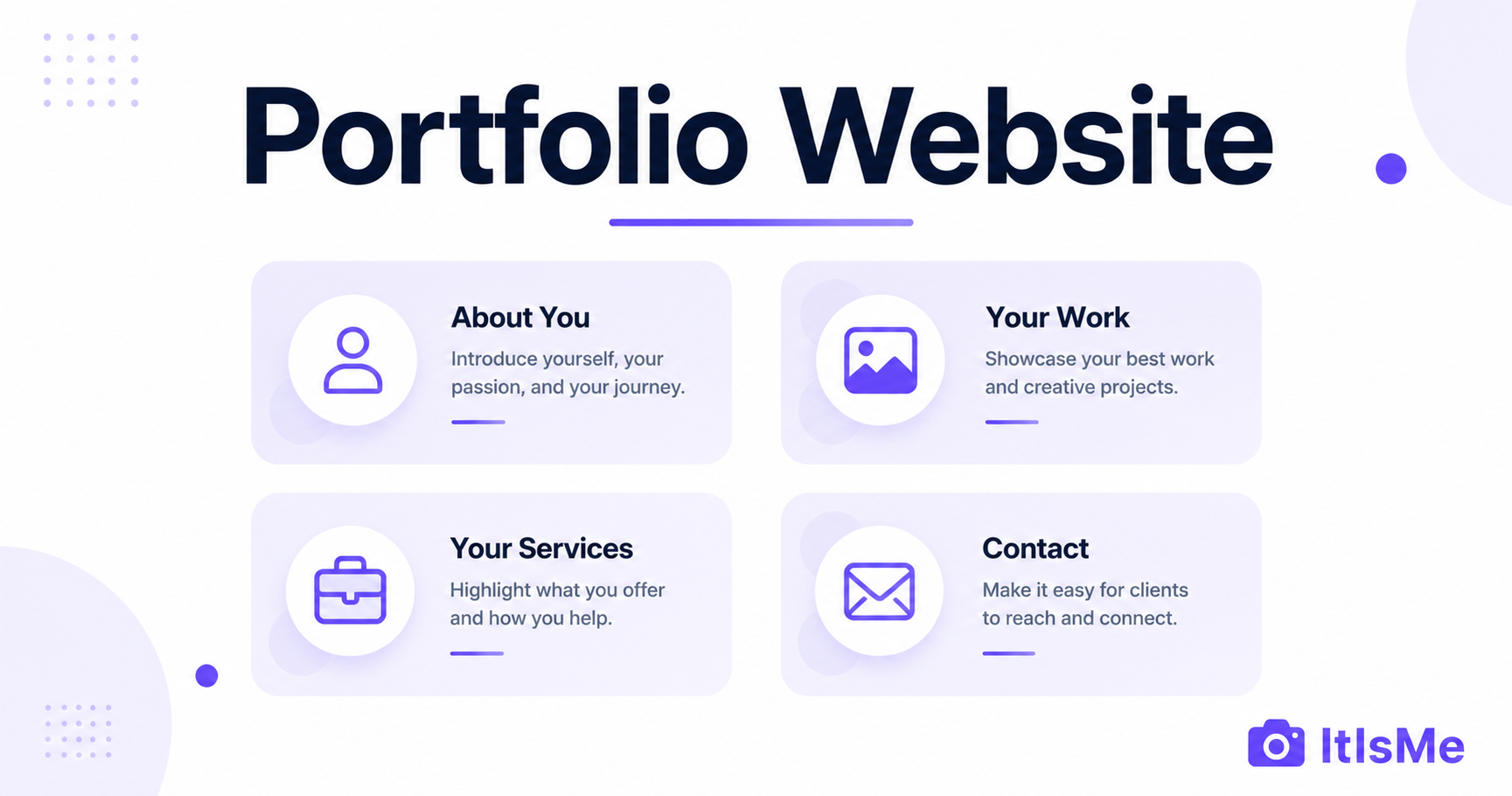
A good portfolio website has six core sections. Not all of them need to be elaborate — even a basic, well-filled portfolio is far more powerful than having no website at all.
1. About Section
This is your professional introduction. Who are you, what do you specialise in, how long have you been doing it, and who do you typically work with? Keep it to 3 to 5 sentences. Write it in first person, keep it honest, and make it specific — "I am a freelance UI/UX designer based in Bangalore with 4 years of experience in SaaS product design" is far more effective than "I am a passionate designer who loves creativity."
2. Work / Projects Section
This is the most important part of your portfolio. Show your actual work — case studies, designs, writing samples, photographs, completed projects, or client outcomes. Quality matters far more than quantity. Five excellent examples beat twenty mediocre ones. For each project, include a title, a brief description of what you did, and ideally a result: what did the client achieve because of your work?
3. Services Section
Tell visitors exactly what you offer and what it costs to work with you. "Logo Design from ₹2,500" or "Social Media Management from ₹8,000/month" removes guesswork and attracts clients who are already in your price range. Listing your services clearly also signals that you are serious and professional — not a hobbyist.
4. Testimonials
A few sentences from past clients or employers have more persuasive power than anything you write about yourself. "Rahul delivered the website a week early and it looked exactly like we wanted" — even that one line converts a hesitant visitor into an enquiry. Ask every person you work with for a short testimonial, no matter how small the project.
5. Contact / Enquiry Form
Make it easy for people to reach you. A simple form with name, email and message field is enough. On a platform like ItIsMe, this is built in — no third-party tool needed. Add your WhatsApp number here too, because most clients in India prefer starting a conversation on WhatsApp.
6. AI Chat Assistant
This one is unique to modern portfolio platforms. An AI chat widget on your portfolio — like the one built into every ItIsMe portfolio — lets visitors ask questions and get instant answers, even when you are unavailable. You train it with your own Q&A: your rates, your availability, your process, your turnaround time. It answers automatically 24 hours a day, turning late-night enquiries into morning leads.
Who Needs a Portfolio Website?
The honest answer is: almost everyone who earns money from a skill or service. Here are the people who benefit most.
Students and Freshers
A portfolio website is your strongest tool during campus placements and job applications. When a recruiter receives 200 resumes, the candidate with a link to their actual work — design projects, coding samples, writing pieces, certificates — stands out immediately. A free portfolio website for students gives you a professional edge before you have a single year of work experience.
Freelancers
For a freelancer, a portfolio website is the difference between chasing clients and attracting them. When someone Google-searches "freelance graphic designer Delhi" or "content writer for startups India," the people with portfolio websites appear. Those without them do not. A free freelancer portfolio is the single most effective marketing tool available at zero cost.
Tutors and Coaches
Home tutors, yoga instructors, fitness coaches, music teachers and online educators all need a way for students to find them, read about their qualifications and experience, see what subjects or batches are available, and make an enquiry. A portfolio website handles all of this automatically — even answering student questions at midnight through the AI chat while the tutor sleeps.
Small Business Owners
A boutique owner, a home baker, a repair shop, a salon, a photography studio, a coaching institute — any small business benefits enormously from having a website where customers can learn about the business, see what it offers, read reviews and get in touch. A free business website is no longer a luxury. It is the minimum credibility threshold a customer checks before calling.
Professionals and Salaried Employees
Even if you are not freelancing or running a business, a portfolio website strengthens your professional brand. It gives you a polished link for LinkedIn, a way to showcase side projects, and a permanent record of your career that goes beyond a 2-page CV.
What Is the Difference Between a Portfolio Website and a Social Media Profile?
| Feature | Portfolio Website | Instagram / LinkedIn Profile |
|---|---|---|
| You own it permanently | Yes — it is yours forever | No — platform can restrict or delete it |
| Appears in Google Search | Yes — indexed by Google | Limited — platform controls visibility |
| Shows your work your way | Yes — full control of layout | No — fixed platform format |
| Dedicated services page | Yes — clear pricing and offerings | No structured services listing |
| AI chat for enquiries | Yes — answers 24/7 automatically | Manual DMs only |
| Professional credibility signal | High — serious professionals have websites | Lower — anyone can create a profile |
| Cost | Free on ItIsMe Basic plan | Free but limited |
How Long Does It Take to Build a Portfolio Website?
On a platform like ItIsMe, a basic portfolio with your name, bio, services and 2 to 3 projects takes about 5 minutes to set up. A thorough portfolio with 8 to 10 projects, client testimonials, a complete services section and a fully trained AI chat takes 30 to 60 minutes — easily done in one evening.
There is no coding, no design software and no hosting to configure. You sign up, claim your URL at itisme.in/yourname, and fill in your sections from your dashboard. Your portfolio is live the moment you save it.
What Makes a Portfolio Website Good vs Mediocre?
The difference is almost never design — it is content. A simple, plainly designed portfolio with specific, honest, well-described work outperforms a beautifully designed portfolio with vague copy and no real examples every single time.
A good portfolio website is specific ("I designed the checkout flow for a Bengaluru-based D2C brand, reducing cart abandonment by 18%"), honest (it shows real work, not exaggerated claims), easy to navigate (a visitor finds what they need in under 30 seconds), and easy to contact (one click to a form or WhatsApp).
A mediocre portfolio says "I am a passionate professional with excellent communication skills" — and shows nothing concrete to back it up.
How Much Does a Portfolio Website Cost?
On ItIsMe, the Basic plan is permanently free — ₹0 per year. You get a custom URL at itisme.in/yourname, a gallery, a services page, a contact form and an AI chat assistant. No credit card required.
The Professional plan costs ₹999 per year (about ₹83 per month) and gives you more project slots, more blog posts and product listing capability. The Enterprise plan at ₹1,999 per year is for high-volume users who want maximum limits across all features.
For most students, freelancers and professionals starting out, the free Basic plan is more than enough to create a professional, working portfolio website that makes a real impact.
Frequently Asked Questions
Is a portfolio website different from a resume?
Yes, significantly. A resume is a text document that lists your experience and education. A portfolio website shows your actual work — designs, writing samples, projects, photos, case studies. A resume tells people what you have done. A portfolio proves it. For most creative and technical professionals, a portfolio is more powerful than any resume.
Do I need coding skills to build a portfolio website?
Not at all with a platform like ItIsMe. You fill in your information, upload your work images, write your service descriptions and click save. The platform handles all the technical work — hosting, mobile-responsive design, fast loading and search engine visibility — automatically.
Can my portfolio website appear on Google?
Yes. Your ItIsMe profile at itisme.in/yourname is publicly accessible and indexed by Google. Over time, as your profile gets visited and linked by others, it builds visibility for searches involving your name, your city and your profession — without any paid advertising.
What if I do not have much work to show yet?
Start with what you have. College projects, personal practice work, mock designs for imaginary brands, writing samples on topics you care about — any real example of your skill is better than a blank portfolio. Add more as you build your career. A portfolio grows with you.
Is there a difference between a portfolio website and a business website?
They overlap significantly. A portfolio website focuses on an individual professional's work and skills. A business website focuses on a company's services and products. On ItIsMe, both work the same way — you set up sections for your services, gallery, contact and blog, whether you are an individual freelancer or a small business owner.
Build Your Portfolio Website for Free Today
A portfolio website is the single most effective professional tool you can have — and on ItIsMe, it costs nothing to start. Your work deserves a permanent, professional home that works for you every day, answers client queries automatically and gives every person who looks you up a reason to choose you.
Create your free portfolio on ItIsMe →
Also read: How to Get More Clients as a Freelancer Using a Portfolio Website | Free Website for Students in India | Free Website for Freelancers in India